
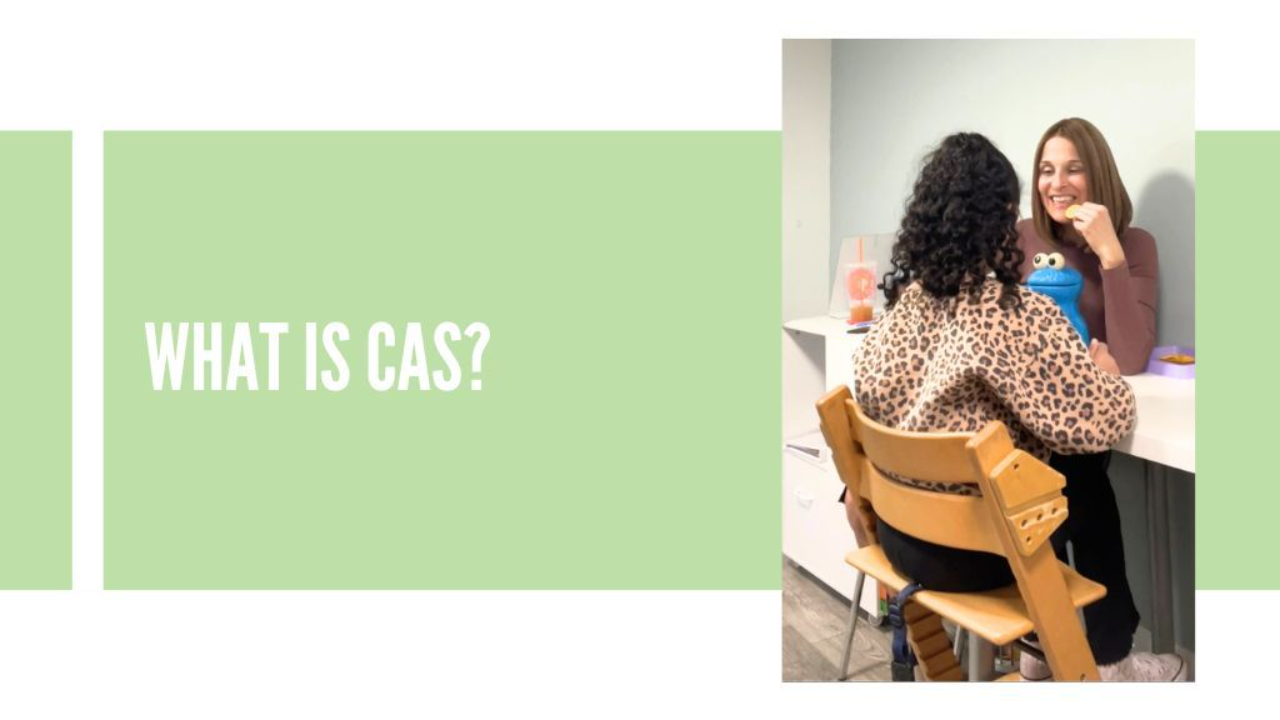
What is Childhood Apraxia of Speech (CAS)?
Apr 26, 2026Childhood Apraxia of Speech (CAS) is a neurological motor speech disorder that affects a child’s ability to plan and program the movements of the mouth, tongue, and jaw needed to produce accurate speech sounds.
Because CAS is a motor speech disorder, treatment typically requires a motor-based approach that targets the planning, sequencing, and coordination of speech movements.
Most SLPs receive limited training in identifying and treating CAS during graduate school. After I graduated, my first job as an SLP was working with children in early intervention. I quickly saw that traditional language-based therapy was effective for most of my clients, but not all of them.
One of my mentors suggested that I learn more about CAS after I shared that I was struggling to help one particular child. That suggestion changed the direction of my career, and I haven’t stopped learning since.
One of my first clients with suspected CAS came to me at age four, still largely unintelligible despite extensive articulation and language therapy. I was able to complete a dynamic assessment, which indicated that a motor-based approach was a better fit for him. Within a single session, we began to see progress.
Helping children and their parents, who have been stuck, finally move forward is one of the most rewarding parts of my job.
Over the years, I’ve had the opportunity to help hundreds of children with Childhood Apraxia of Speech make meaningful progress and improve their ability to communicate. Because CAS and motor-based treatment are not taught extensively in graduate school, I’ve brought my decades of clinical experience and ongoing learning together in a comprehensive Childhood Apraxia of Speech course for SLPs.
In this post, you’ll learn more about what CAS is, how it differs from other speech sound disorders, and how SLPs can better support children with CAS or suspected CAS.
What causes Childhood Apraxia of Speech?
There is no known etiology (cause) for CAS. Childhood Apraxia of Speech is a neurologically based speech sound disorder that can be seen as a standalone disorder or paired with other diagnoses.
Children with Down Syndrome and Autism have a high co-occurrence of CAS.
If there are no comorbidities, children with CAS don’t have low oral muscle tone (this is different if Down Syndrome is present) and should not be treated with non speech oral motor exercises (NSOMES).
The only evidence-based treatment for suspected CAS and CAS is what’s known as Principles of Motor Learning. PML is the structure for how target words are practiced within apraxia therapy. It’s important for SLPs to note that practicing speech movement sequences helps children with CAS improve their speech. Traditional articulation therapy is not effective as it teaches sounds in isolation and doesn’t support the child through the movement from one sound to the next.
If you’re a parent with a child with CAS, a quick Google search will tell you that CAS is a lifelong disorder. This can be scary, because it feels like your child will always have difficulty communicating. It can also be intimidating for SLPs to share these results with parents.
But parents and SLPs should know that while CAS may cause difficulty learning more difficult words across a child’s lifespan, with consistent motor speech treatment, children with CAS can learn to speak intelligibly. Most clients make significant progress once Principles of Motor Learning are used in therapy.
How is CAS different from other speech sound disorders?
Unlike phonological disorders that are linguistic and pattern-based, CAS is a disorder that causes difficulty with movement sequences and requires motor speech treatment.
With phonological disorders, children substitute one class of sounds for another. These types of disorders are treated with minimal pairs, like “fan vs. van” or “tar vs. car”.
Children can have both CAS and a phonological disorder. The SLP needs to prioritize goals by determining which disorder is affecting the child's intelligibility the most.
Children with CAS as the primary diagnosis have no issues with receptive language. They understand language well, but they need to work on sequencing their speech motor movements with Principles of Motor Learning.
Learning more about CAS can help SLPs better diagnose and treat children with CAS and children with other speech sound disorders.
What are the signs of Childhood Apraxia of Speech?
Some of the key signs of CAS include:
- Inconsistent sound errors
- Difficulty transitioning between sounds
- Improper stress on syllables (robotic speech)
- Difficult imitating sounds or words
- Vowel distortions
If you’ve never been taught to look for these signs, or that they’re an indication of a potential motor speech disorder, you’re not alone.
I launched my Instagram account in 2022 because I wanted to help teach SLPs more about CAS. I didn’t learn about CAS in graduate school, and I knew that with the right information and training, other SLPs could be more successful with their clients with CAS.
My Instagram account grew into my website with a blog about CAS and apraxia therapy, and eventually led to me creating comprehensive apraxia courses for SLPs and CAS courses and resources for parents.
There is a misconception that a child needs a confirmed diagnosis of CAS before an SLP can use a motor-based therapy approach. This is not necessary. If a child is not responding to a language-based approach, an SLP can consider using a motor speech approach even without a confirmed CAS diagnosis. In fact, trying a motor-based approach may provide valuable information about how the child responds to motor speech treatment.
What are the evidence-based treatments for CAS?
There are several different approaches SLPs should know and be able to use to treat Childhood Apraxia of Speech, including Dynamic Temporal and Tactile Cueing (DTTC) Prompts for Restructuring Oral Muscular Phonetic Targets (PROMPT) and Rapid Syllable Transition Training (REST).
DTTC uses a temporal hierarchy with multisensory cueing to build the motor plan and then fades cueing to generalize the motor plan. Principles of Motor Learning are used throughout the hierarchy.
PROMPT is a tactile-kinesthetic approach used to treat Childhood Apraxia of Speech. It incorporates touch-pressure cues to the jaw, lips, and tongue to support accurate motor movements for speech.
PROMPT cues help:
- Strengthen motor planning
- Support the development of new neural pathways
- Improve overall speech clarity
While PROMPT is especially effective for children with motor-based speech disorders like CAS, it can also be beneficial for individuals with Dysarthria or severe articulation difficulties.
REST is especially used for children with childhood apraxia of speech who can produce some speech but need help with accuracy, consistency, and prosody.
If you’re interested in learning more about specific therapeutic tools and techniques to treat children with CAS, be sure to check out my courses for SLPs. I also recommend the resources and learning offered by Child Apraxia Treatment and Apraxia Kids.
What CAS questions do SLPs ask?
You don’t know what you don’t know. It can be hard for SLPs to learn about Childhood Apraxia of Speech because they don’t even know where to start.
In my decades of training and teaching SLPs about apraxia therapy, here are some of the most common questions SLPs ask as they begin to learn more about CAS.
At what age can a child be diagnosed and treated for CAS?
A CAS diagnosis doesn’t come at a specific age. Children can be diagnosed when they can participate in a dynamic assessment. When we see discriminative characteristics of CAS during this assessment, we can make a diagnosis. Some children can participate at a young age while some cannot.
Can a child have CAS and another speech sound disorder?
Yes! I often treat children that have CAS and another speech sound disorder like phonological pattern disorder or articulation deficits. This can present as a child who demonstrates fronting and has a lisp.
How many times a week do you treat a child with CAS?
Frequency of treatment varies based on things like finances, the parent and child schedules, and distance that must be traveled to and from therapy. Most of my clients with CAS come to therapy twice a week for thirty minute sessions. Carryover is a very important part of my therapy, so I also coach parents and school SLPs so they can effectively practice the child’s target words.
How do you work with a child who has poor eye contact?
Direct eye contact is not a prerequisite for apraxia therapy. What’s most important is that the child demonstrates joint attention in order to participate in dynamic therapy. This means that the child needs to participate in the same activity and attend to the clinician’s face and mouth to learn more about the movement for speech.
My client demonstrates poor attention and will only repeat the target word once. How do I increase the number of repetitions?
That’s okay! Start with one repetition and build from there. It takes time to build rapport with young clients. This is a normal part of the process.
If the child was receiving language based treatment, they’re not used to toys being withheld until they repeat the word. The child may not be used to sitting and attending to multisensory cueing, so start small and work on increasing expectations in therapy during each session.
Confidently treating CAS
As you learn more about Childhood Apraxia of Speech, you will start to identify when clients may benefit from a motor-based therapy approach. If you work with an early intervention population, it’s likely you will have a client with CAS, whether it’s diagnosed or suspected.
There are 3 things every SLP needs to know about the treatment of Childhood Apraxia of Speech:
- The child must practice the movements to improve speech motor planning skills. Being exposed to the word and or hearing it modeled for them doesn’t help them build the motor plan.
- It is important to work on meaningful and functional words. Don't use a flashcard deck with random vocabulary. What is meaningful to one child may not be meaningful for another, so ask for family input when choosing words for each specific child.
- You need to elicit accurate repetitions of the target word. Repetition of the target word is an important Principle of Motor Learning, and it’s crucial that they practice the movements and sounds accurately.
Don’t feel bad if you are unable to treat a current or future client with CAS. Effective treatment of CAS requires post-graduate courses specifically in Childhood Apraxia of Speech.
Attempting to treat CAS without proper skills can lead to significant frustration for the child and the SLP. This can cause children to become uncooperative, misbehave in sessions, and potentially develop poor self-confidence.
The power of apraxia therapy
Successful apraxia therapy can be life-changing. A while ago, I began working with an 18-month old. The child’s parent is an SLP and was working with the child as well as engaging with early intervention language therapy.
Despite all the efforts of the parent and the other SLP, the child had made virtually no progress in their verbal communication.
I began seeing this child three times a week using a motor speech therapy approach. We started with imitating sound effects and holding out sounds to keep the child’s voice “on.”
Within just six months (and a lot of carryover work by the family at home!), the child is consistently using words to communicate and has moved into simple phrases! Every session together I am reminded of just how powerful motor speech treatment is and how it completely changes progress for children with suspected or diagnosed CAS.
Key takeaways
- Childhood Apraxia of Speech is neurological motor speech disorder that affects a child’s ability to plan and program the physical movements needed to produce accurate sounds.
- There is generally not adequate education or training about CAS or motor based therapy provided to SLPs in traditional graduate school courses.
- Principles of Motor Learning is the evidence-based treatment approach for CAS or suspected CAS.
- DTTC and PROMPT are effective techniques used in motor-based therapy.
- A child with CAS or suspected CAS must practice movements in order to improve speech motor planning skills.
- Target words used in therapy should be meaningful and functional for the specific child.
- Accurate repetition is the key to making progress in motor-based therapy.
If you would like to learn more about how to structure motor-based therapy with Principles of Motor Learning, you can sign up for my free guide here
Free Target Selection Handout for CAS
Learn how to choose target words for minimally verbal children, understand
multisensory cueing, and other do's and don'ts in apraxia therapy.
