
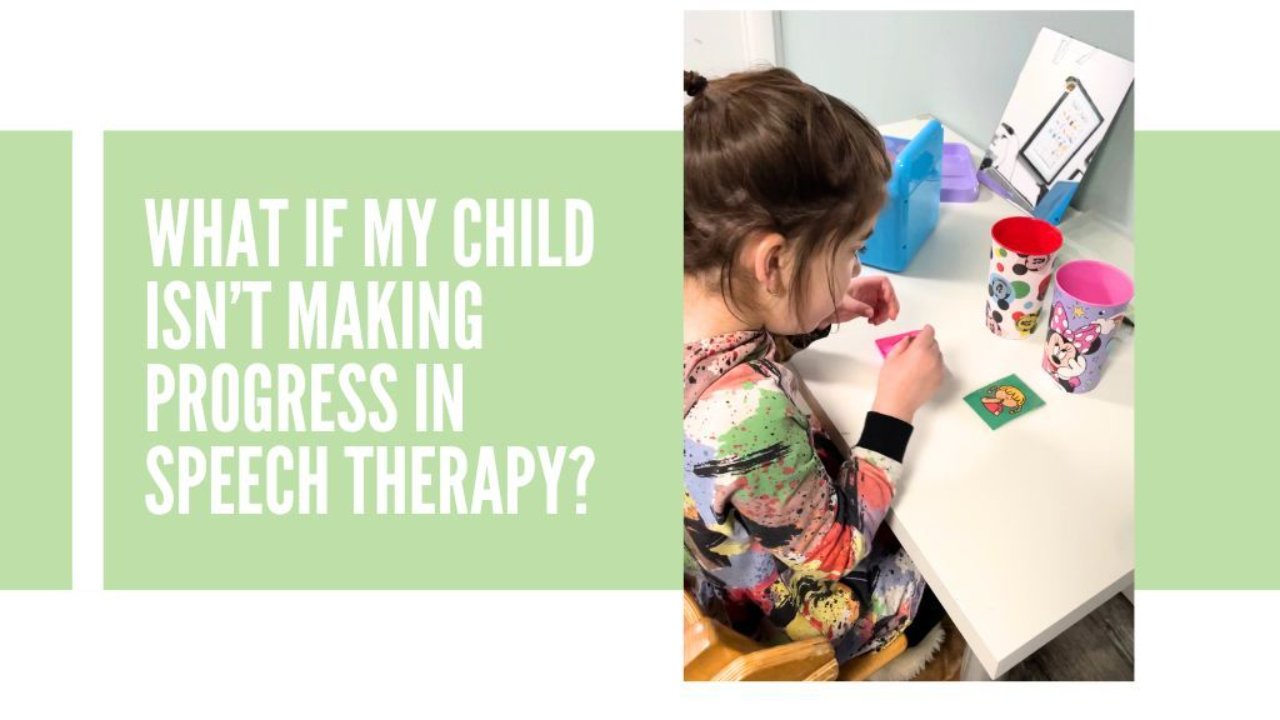
What if my child isn’t making progress in speech therapy?
Apr 12, 2026I receive many assessment inquiries from parents who are frustrated that their child is not making progress in speech therapy.
It is always a good idea to start by having a conversation with your child’s SLP to discuss your concerns. Ask the therapist if other treatments might be helpful and if childhood apraxia of speech is suspected.
When children with childhood apraxia of speech are treated with a language, articulation or phonological approach, progress will be slow. Lack of progress isn’t always due to poor therapy skills or your child’s participation… it’s simply targeting the wrong kind of practice and skills.
How is CAS different from an articulation or phonological disorder?
Articulation errors are single sound errors that are treated by teaching the child how to produce a specific sound. Phonological errors are based on error patterns and are treated using minimal pairs.
CAS is a disorder that involves movement sequences. Children with CAS have difficulty moving from one sound to the next, and this issue is not effectively treated with the same therapy approach as articulation and phonological errors.
Dr. Edythe Strand (2020) defined 10 discriminative characteristics that we look for when CAS is suspected.
If you notice one or more of these characteristics, your child would probably benefit from an evaluation:
- Awkward movement from one articulatory configuration to another
- Groping and/or trial-and-error behavior
- Vowel distortions
- Prosodic errors
- Inconsistent voicing errors
- Intrusive schwa
- Inconsistency of word or phrase production over repeated trials
There’s one big question we need to answer in order to find the most therapeutic approach: Does the child have an articulation issue, a phonological issue, or a motor planning issue?
It’s important to note that children can have both CAS and another speech sound disorder.
Who can diagnose Childhood Apraxia of Speech?
CAS should be diagnosed by an SLP who is trained to work with children with childhood apraxia of speech. I’ve worked with parents who have shared that a medical professional made the diagnosis of CAS, but CAS is a speech sound disorder, not a medical diagnosis.
Professionals diagnose CAS with a thorough, dynamic motor speech assessment. Most speech assessments ask the child to repeat words and the SLP writes down the child’s production, but a dynamic motor speech assessment seeks to help the child produce the word with improved accuracy by providing multisensory cueing and giving the child more information about the movements.
An SLP will actively work with a child during a dynamic motor speech assessment, challenging the child to produce words with a variety of syllable shapes of increasing complexity so they can see where the child’s production breaks down.
This increasing complexity can look like asking the child to say:
- Me (consonant + vowel)
- On (vowel + consonant)
- Mom (consonant + vowel + consonant)
- Mommy (consonant + vowel + consonant + vowel)
The motor speech assessment provides an SLP with information about how a child moves their lips, tongue, and jaw to produce sounds. It allows the SLP to assess repeated productions of the same word, assess vowel errors (articulation tests do not assess vowels), and examine prosody — the child’s intonation patterns.
When multisensory cueing is provided within the dynamic assessment, the SLP can determine if the child has a diagnosis of CAS and what cues are the most impactful.
If you’re interested in learning more about the evaluation process and how you can support your child with CAS or suspected CAS, click here for more info about parent resources.
What does apraxia therapy look like?
Apraxia therapy is a structured motor speech approach.
This type of therapy focuses on movement sequences. SLPs use principles of motor learning (PML) to build new motor plans which the child will practice while the SLP provides multisensory cueing.
The goal of apraxia therapy is for the child to produce the movement without support.
A peek inside an apraxia therapy session
In addition to training SLPs and supporting parents, I provide one-on-one apraxia therapy sessions through my private practice. Here’s what a real apraxia therapy session might look like.
Based on the child’s repertoire of sounds, I’ll choose a small list of power words and practice them by engaging the child in meaningful activities.
To practice the word “out” I would have the child practice the word first, then take an object “out” of a box, door, Easter egg, etc.
Research shows that children with CAS initially need a lot of frequent, constant practice of their target words to learn the motor plan. The number of sessions per week will vary depending on access to a trained SLP.
Parents who are able to support can play an active role in practice and even be trained by an SLP to practice at home with their child. (I offer several different resources for parents!)
Apraxia therapy in school
Apraxia therapy can be done in school if the school has an SLP that is trained in motor speech therapy.
If you’re requesting motor-based therapy in school, make sure to request one-on-one sessions with the clinician to maximize practice of the child’s target words.
If the school does not have an SLP that is trained to work with CAS, you can request that the school provide training so your child can get appropriate services.
If possible, I highly recommend seeking private speech therapy with an SLP trained in CAS.
Children with CAS, without co-morbidities, will often be full, verbal communicators. The potential for improvement and progress relies on working with an SLP who utilizes principles of motor learning and can structure an individualized therapy program for your child.
Treating CAS requires postgraduate training, and it is perfectly acceptable to ask the SLP about their training.
How can I support my child with CAS?
The best way you can support your child with CAS is to be trained by an apraxia therapy specialist or your child’s SLP who has experience working with CAS.
Training can take on many different forms including observing a session with your child, watching videos shared by the clinician, or completing courses specifically created to educate and equip parents.
I usually advise my clients to set aside small periods of time for speech practice and then be a parent the rest of the time.
Practice at home is very individualized and based on the following factors:
- Amount of time the parent has to practice
- Size of the family
- Cooperation of the child
Your SLP should work with you to structure at-home practice for success. What works for one child and family may not work for yours, so it’s important to work together to figure out what’s best for your child and situation.
You may want to tell your child that you understand speech can feel hard. This is absolutely okay to share!
As an SLP, I always tell my clients that I’m here to help them with their speech. At home and in therapy, it’s important to compliment children for their effort, not just perfect productions.
Complimenting your child for other skills is a great way to build their confidence within speech practice. Saying things like “I like the tower that you built” or “Wow! You drew a pretty picture,” can help keep your child engaged in practice, even when it’s hard.
Will my child with CAS speak more clearly?
When your child is evaluated, an SLP can usually provide you with appropriate therapy expectations. Potential progress is based on the severity of the apraxia, your child’s cooperation in therapy, and family support.
In general, the first 6 months of motor-based therapy are typically very challenging as the child learns to attend to cueing and structured therapy. As they master the foundational skills and start building motor plans, progress usually moves along at a faster pace.
CAS therapy is a marathon, not a sprint. It takes time to see progress. Children with CAS are usually in frequent speech therapy for several years with less frequent therapy support afterwards. The months or years of intense therapy can be stressful for families. You can always have a discussion with your SLP about taking a small therapy break if it becomes too stressful.
While progress may be slow at first, it’s important that your child see some improvement along the way. Children’s confidence increases as they learn to produce their “power words” and this success tends to keep them engaged and wanting to learn more.
Is it too late to help my child with CAS once they’re in school?
It is never too late to have your child begin CAS therapy.
Often the right therapy approach is all children need to build intelligible speech. In my decades of experience, I have started treatment with children of all ages and have seen them all be able to build and improve their verbal communication skills.
If you have any questions or concerns about your child’s progress or experience in therapy, always speak to their SLP and school team.
When your child’s needs are not being met, you do have the option to hire an advocate or work directly with the school to ensure your child is receiving the services they are entitled to.
I’ve created resources, tools, and a course specifically for parents of children with CAS (or suspected CAS) to help you support their progress and success. Click here to check out all the parent resources!
Free Target Selection Handout for CAS
Learn how to choose target words for minimally verbal children, understand
multisensory cueing, and other do's and don'ts in apraxia therapy.
