
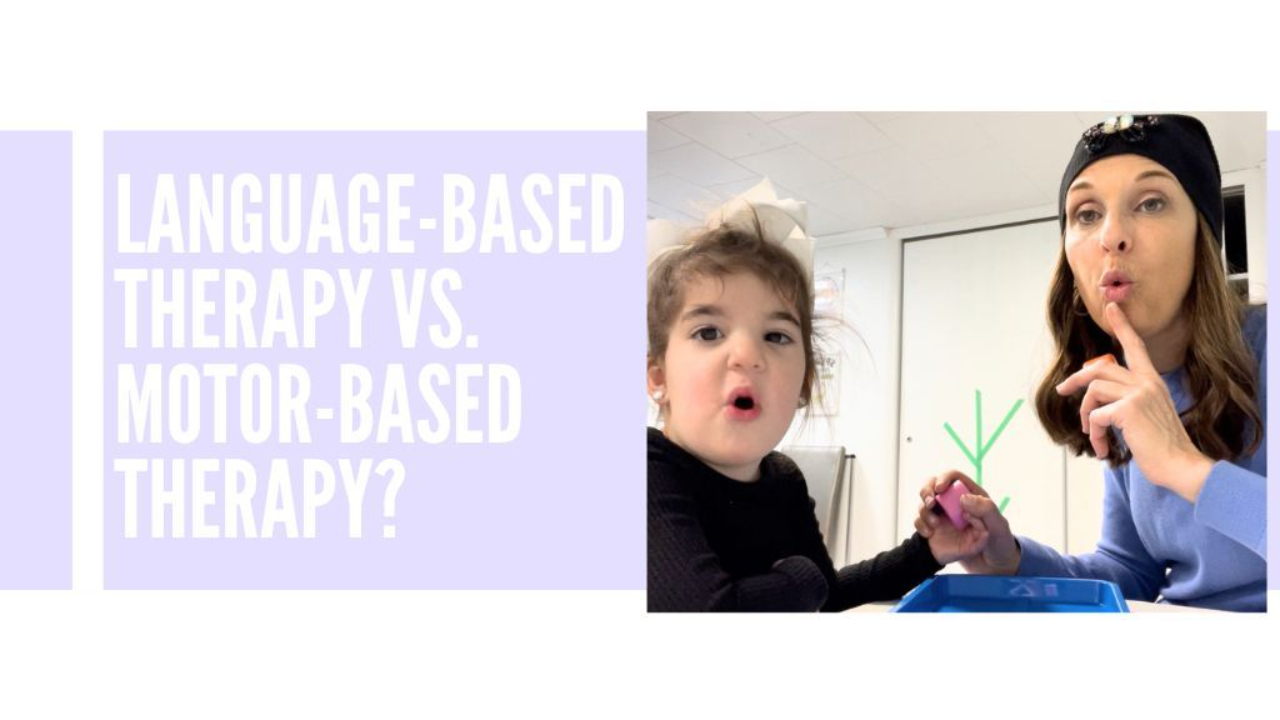
What is the difference between language-based therapy and motor-based therapy?
Mar 29, 2026SLPs don’t just do one type of therapy.
Depending on the client’s needs and goals, there are different approaches we can use to help clients reach their goals and make meaningful progress.
Language-based therapy is typically the most common type of therapy used by SLPs, especially when working with school-aged clients. But this is not the only approach.
When it comes to Childhood Apraxia of Speech (CAS), language-based therapy isn’t an effective approach.
This post examines the differences in the language-based therapy approach most SLPs are comfortable and confident with and the motor-based therapy approach that works best for clients with CAS.
Two different types of therapy
Language-based therapy focuses on developing a child’s ability to understand and use language for communication.
Treatment targets skills like:
- Vocabulary development
- Grammar
- Sentence structure
- Comprehension
- Ability to express ideas clearly
Language-based therapy often includes activities like describing pictures, answering questions, building sentences and participating in conversation or storytelling.
Clinicians support children in expanding their expressive language and improving their understanding of spoken language in meaningful contexts. The goal of language-based therapy is to strengthen the child’s overall language system so they can communicate effectively in everyday interactions.
Motor-based speech therapy, in contrast, focuses on the movement and coordination of the speech muscles required to produce sounds and sequences of sounds accurately.
Treatment emphasizes:
- Repeated practice
- Carefully structured cueing (multisensory cueing)
- Principles of motor learning
Motor-based therapy helps the child plan and execute speech movements. Rather than focusing on phonological rules, therapy targets accurate motor planning and sequencing of syllables and words.
The goal of motor-based therapy is to build consistent, automatic speech movements that result in clearer speech production.
Why is it important for an SLP to understand different types of therapy?
If an SLP doesn’t understand the different types of therapy and how they target different skills, treatment will not be as effective.
Using a language-based approach for a child with a motor-based speech disorder won’t give the client the intensive movement practice they need in order to improve their motor speech skills.
Using the wrong approach typically leads to slow (or no) progress and can be highly frustrating for both the clinician and the client. The wrong therapeutic approach can lead to children losing motivation to participate.
When an SLP understands the different types of therapy and when each approach should be used, they are able to better target the child’s actual area of needs and support more efficient, meaningful progress.
There is no downside to treating suspected apraxia of speech with principles of motor learning.
When should an SLP use language-based therapy?
Each time you begin working with a new client, it’s important to complete a full battery of informal and formal assessments so you can make a differential diagnosis.
Many children may present with a combination of speech and language issues. When this occurs, SLPs should prioritize treatment for what is affecting the child’s communication and speech the most.
Using language-based therapy is most effective when developmental language disorders and literacy-related challenges. Clients who require language-based therapy often present with a limited vocabulary, has difficulty answering questions, struggles to follow directions, and difficulty with social communication.
A child with delays due to underlying motor speech deficits wouldn’t make progress with language-based therapy the same way a child with developmental delays.
Choosing the right type of treatment
Once you complete an assessment, you can determine whether the child has a language-based disorder with no speech deficits or a combination of both. Children with CAS often demonstrate delays in their language skills as a result of their motor deficits.
Research into why children with CAS demonstrate these language skill delays is mixed. Different studies indicate these delays may be due to:
- The child’s limited early experiences with language.
- The child has difficulty producing more complex syllable shapes and therefore falls behind in their grammar skills.
- Children with CAS may have language delays as part of the disorder.
Language based therapy is often play-based. This means an SLP will use various activities such as a dollhouse, pretend food, or lego sets to model new vocabulary, longer phrases, and social communication.
Many children benefit from the clinician engaging the child in real life experiences such as preparing food or talking together about upcoming or past family trips or occasions. Embedding language practice into meaningful activities will improve generalization of those skills for children who present with language-based disorders.
When should an SLP use motor-based therapy?
Childhood Apraxia of Speech (CAS) and Dysarthria require motor-based treatment approaches that target speech movement patterns rather than individual sounds in isolation.
Motor-based therapy typically involves:
- High-intensity practice
- Multisensory cueing
- Principles of motor learning (including frequent practice, feedback, and gradual increase in complexity)
Evidence-based approaches include Dynamic Temporal and Tactile Cueing (DTTC) and other motor-planning treatments for CAS, while dysarthria therapy often focuses on improving strength, coordination, and respiratory-phonatory control to increase intelligibility.
If a motor-based speech disorder is suspected, then a dynamic motor speech assessment should be performed. This means that the child needs to be able to imitate or attempt imitation of words and attend to cues (via the principles of motor learning) to improve production.
When the child attempts production of new words and movement patterns, we can usually see the discriminative characteristics or symptoms of childhood apraxia of speech and/or characteristics of dysarthria. A differential diagnosis also must be made between dysarthria and CAS.
What does motor-based therapy look like in practice?
A child with a speech motor disorder, such as childhood apraxia of speech, doesn't benefit from the same type of practice that children with language-based disorders respond to.
While they can understand and categorize words through routines, merely hearing the word doesn't assist in developing the motor plan.
For children with CAS or suspected CAS, it’s crucial that they get repeated, consistent practice making speech movements and combining them accurately to form words.
Utilizing multi-sensory cues and principles of motor learning is essential for children with speech motor disorders to effectively practice sound and word production.
Multisensory cueing in motor-based therapy
Children with CAS have difficulty with movement sequences –– the movement between sounds and syllables within a single word and movement from one word to the next within a sentence or phrase.
Multisensory cueing is very important in apraxia therapy because it provides the child with more information about how sounds are produced and supports them throughout the movement sequence.
In language-based therapy, an SLP may or may not use multisensory cueing. Children with a language delay can benefit from cueing, but it is not a necessary component.
In motor-based therapy, multisensory cueing is an essential component for the acquisition of the motor plan. In other words, multisensory cueing is at the heart of motor-based therapy.
Multisensory cues include:
Visual cues: Show the child how to make the sound by directing the child to watch your mouth, look in the mirror or look at sound cue cards.
Hand Cues: Use your hand like a puppet to mirror the movement.
Tactile Cues: Gently guide the child’s jaw, lips, or cheeks to help them feel the movement.
Auditory/Verbal Cues: Give clear directions or fun metaphors like “make the snake sound” for /s/.
Multisensory cueing is used to acquire the motor plan, but it’s important that an SLP fades the cueing to help the child generalize the motor plan. As the client practices the word and movements, they require less cueing to produce the movements accurately.
An SLP can use multiple cues at the same time. This is a good way to fade cueing support. For example, if you start with verbal and tactile cues, you can move to only a verbal cue and then progress to just miming the word.
Data-collection methods may differ between articulation therapy and motor-based therapy
In articulation therapy the SLP may take data with every trial. In apraxia therapy, clinicians often do not take data on every single trial because therapy needs to remain dynamic. During treatment, the clinician is constantly adjusting cueing to help the child succeed.
When attention is focused on tallying each response, it can be easy to miss what matters most: the quality of the child’s production.
Instead, it’s important to listen closely and observe how the child’s productions change during practice. Within a single block of trials, a child may move from needing full support to producing the word with much less help.
Need help structuring motor-based therapy for your clients?
Motor-based therapy is built around the principles of motor learnings (PML). Principles of motor learning is the structure of motor speech therapy.
PML guides therapy from motor learning to generalization of the motor plan.
Click here to download a free handout that breaks the structure down for you. Keep it in your desk when you need a refresher!
Free Target Selection Handout for CAS
Learn how to choose target words for minimally verbal children, understand
multisensory cueing, and other do's and don'ts in apraxia therapy.
