
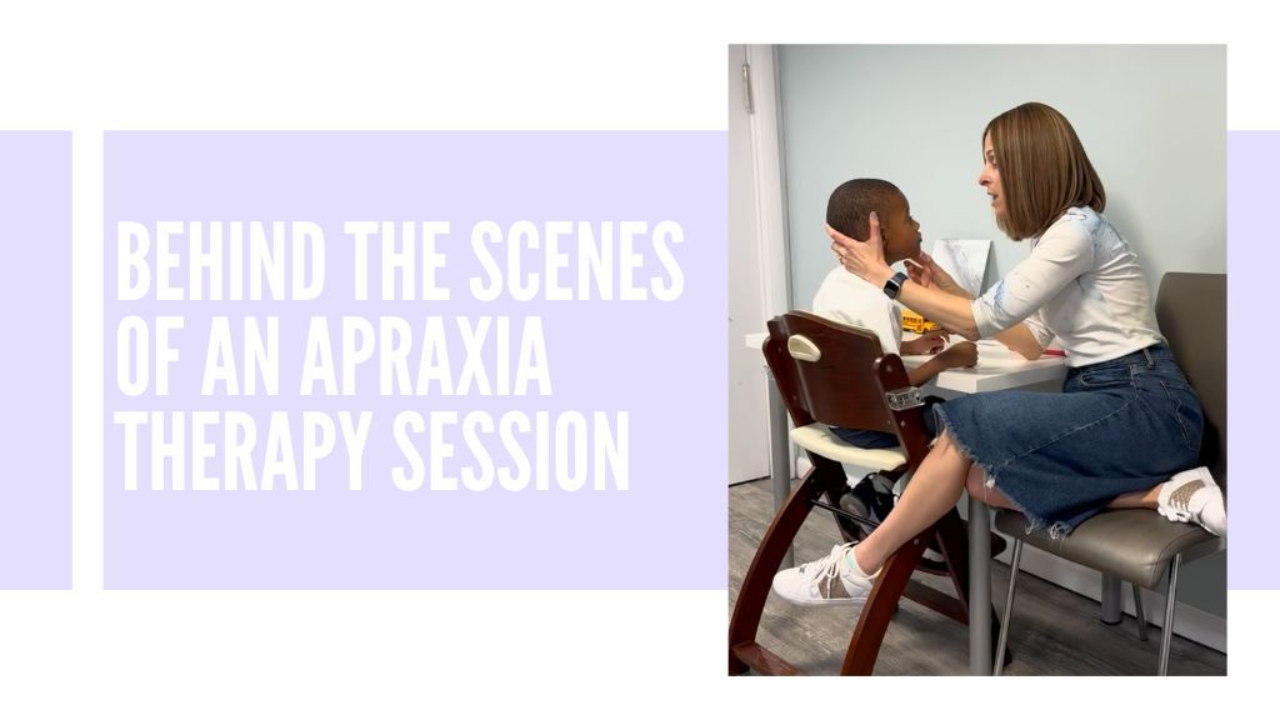
Behind the Scenes of an Apraxia Therapy Session
May 20, 2026What does apraxia therapy look like?
Today, I’m taking you behind the scenes of a real apraxia therapy session to show you what we do, how to prepare, what toys and tools are helpful, and tips for engaging young children in apraxia therapy.
Whether you’re an SLP interested in supporting your clients with motor-based therapy or a parent whose child is starting apraxia therapy soon, you’ll feel more confident when you know what to expect.
What happens in apraxia therapy?
The goal of an apraxia therapy session is to practice the child’s target words with lots of repetition.
Repetition of the motor movement builds the motor plan. Once the child is able to produce the word, the goal moves towards generalization of that word.
When a child generalizes a word, they can use the word in regular conversation.
How should an SLP prepare for an apraxia therapy session?
SLPs need to think about target words before the session begins. This includes identifying the target words for the child to practice as well as the specific activities you’ll use to target those words. It’s always helpful to have backup materials prepared, too.
Other things to prepare before an apraxia therapy session include:
- Cueing you plan to use
- Speech sound cue cards if necessary
- Mirrors
- Dry erase markers
- Ensure the room is cleared of any distractions
I always take out the child’s therapy note from the previous session with the list of the words that we are targeting and the highest level on the DTTC hierarchy that the child was able to practice the word.
I will prepare several toys on a small table near the therapy area that can be used to elicit the target words so the child can choose a toy while allowing me to effectively target specific words.
One helpful tip is to keep your phone on a stand to take small videos the parent or school SLP can use to do carryover.
Apraxia therapy sessions involve a lot of modeling, talking, and cueing, so I like to have a water bottle or coffee nearby!
Successful apraxia therapy
SLPs need to understand what makes an apraxia therapy successful so they can measure progress and share key details with parents.
A successful apraxia session doesn’t necessarily mean the child generalized every target word. These are skills that take time, so we want to focus on progress.
A session is a success if you see at least one of the following:
- Progress in building or generalizing the motor plan for a specific word or phrase.
- Increased attention to cueing.
- Increased number of repetitions of the target word or phrase.
- Increased number of words practiced during the session.
Toys to use in apraxia therapy
Toys are an important part of apraxia therapy. We use specific toys to help children practice their target words in a way that’s meaningful, engaging, and fun.
The best toys to use in apraxia therapy are open-ended toys.
Open-ended toys can be used in a number of creative ways to target a number of different words.
Some common examples of open-ended toys include:
- Plastic eggs
- Blocks
- Wooden or plastic animals
- Mini vehicles
- Little People
- Train sets
Which words can you target with open-ended toys?
If you’re practicing a word that’s a noun, it’s easiest to use a toy representation of that word, like car, cat, dog, tree, apple, etc.
But open-ended toys can be used to target any number of words.
You could put an object inside a plastic egg to practice words like in, on, out, who, what, where, hi, or bye.
You could use a Little People figure to practice verbs like go, come, see, hide, find, fly, eat, hop, jump, and sleep.
Mini vehicles are a great way to practice words like up, down, top, one, two, etc.
Choosing the best open-ended toys
Try to collect a wide variety of open-ended toys so you can find something that appeals to each individual child.
I always try to pair the toys I choose to the child’s interests because it helps them engage in therapy and holds their attention longer.
You can click here to browse my top recommended toys for apraxia therapy.
Make sure to choose toys that aren’t too complex. They are a tool for therapy and shouldn’t distract the child from practicing their target words.
I always keep a small tray or bag so I can keep toys organized and make sure the child only has one toy at a time so they can focus and remain on task.
And if you’re ready to improve your play-based apraxia therapy, check out my Toys and Tools in Apraxia Therapy course. It breaks down everything you need to make therapy sessions more motivational and fun so you can help your clients see meaningful progress and results! You will also gain access to my POWER WORD resource, when you sign up.
Engaging young children
Working with young clients can be very rewarding, but it can also be quite challenging to keep them engaged and focused.
Apraxia therapy is difficult, and the child may not want to engage in the process, so building rapport is very important. It’s best to start by creating trust and rapport before getting into the hard work. (Check out this post for more information about how to build rapport and download a free resource!)
One of the best ways to keep a child engaged is to use toys or activities that are motivating to them. Find out what TV characters they like, specific types of toys they prefer, and provide several choices throughout the session so the child feels empowered.
If a child has sensory differences, it’s important to incorporate activities that help regulate their system and improve attention. This can make a huge difference in their ability to participate and practice.
It can be very frustrating when a session starts going south, especially because children with CAS need a high level of repetition and every minute counts.
The first (and most important) tip? Don’t get frustrated. Staying calm allows you to think clearly and supports co-regulation, helping the child get back on track more efficiently.
For deeper strategies on keeping children engaged and cooperative, check out the Connection and Cooperation course.
What to do when a child struggles during therapy
I used to work with a client who would shut down whenever we started working on a new word or phrase.
He knew that it was difficult, so he would put his head down or even tell me that it’s too hard for him. At that moment I knew that the best way to gain his trust was to agree with him.
“You’re right. Practice is hard. That’s why I’m here to help you!”
I told him that I would take him slowly through the movement and the word, helping him until he could do it. I reminded him that he has learned to produce many difficult words and that I have helped him be successful in the past.
Validating his feelings made him trust me, and he agreed to try.
When you have a child who struggles to engage or stay focused, keep working on building the rapport and trust. These are important things that will be needed in different ways throughout the child’s apraxia journey.
Mistakes SLPs make when clients aren’t engaged in apraxia therapy
No matter how good you are at your job, you will have children who don’t want to practice or engage. It’s a normal part of the job.
The biggest mistake I see SLPs make is getting excited and trying to overcompensate.
Instead of overdoing it, take a pause and try to figure out why the child isn’t engaging.
It could be something as simple as choosing another toy or providing distraction. Instead of focusing on the child’s whining or crying, I change the subject completely. I might pretend that I forgot to take out a special toy or that I have a new app on my phone. An easy distraction is to ask the child about something they are wearing.
Distraction can be a great way to get the session back on track.
Key takeaways
- Apraxia therapy requires a lot of repetition of specific target words.
- The goal of apraxia therapy is for a child to generalize new words, which means they can accurately produce and use that word in real conversations.
- One of an SLP’s most important responsibilities before beginning an apraxia therapy session is to choose the target words for the child to practice and the toys they will use to practice the target words.
- The best toys for apraxia therapy are open-ended toys.
- You can use one toy to practice a wide range of target words.
- Children will struggle to stay engaged in an apraxia therapy session. This is a normal part of the process.
- You can increase a child’s engagement by choosing toys they’re specifically interested in and intentionally building trust and rapport with each child.
- When a child gets off task, distraction is one of the best strategies for getting them to refocus.
Free Target Selection Handout for CAS
Learn how to choose target words for minimally verbal children, understand
multisensory cueing, and other do's and don'ts in apraxia therapy.
