
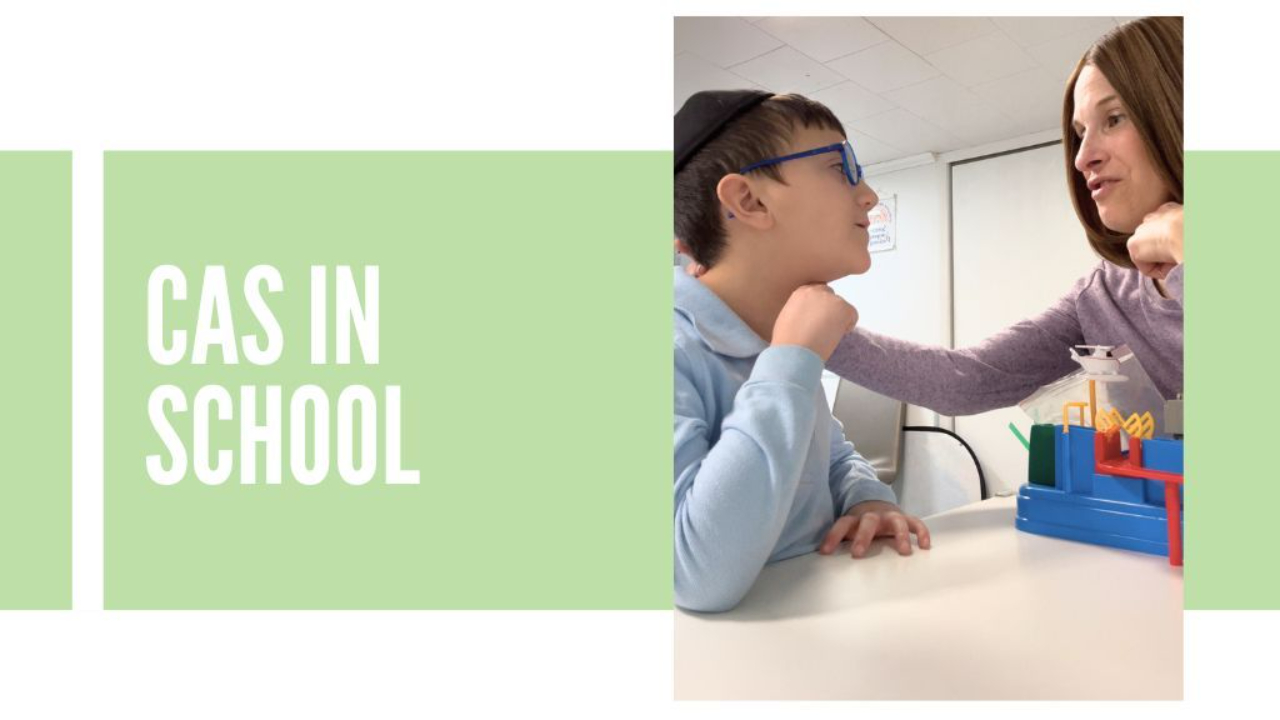
CAS in School
Feb 22, 2026What is CAS?
Childhood Apraxia of Speech or CAS is a neurological motor speech disorder. When a child has CAS, their brain struggles to plan and program the physical movements required to produce sounds.
The National Institutes of Health defines CAS as:
“A neurological disorder that affects the brain pathways involved in planning the sequence of movements involved in producing speech. The brain knows what it wants to say, but cannot properly plan and sequence the required speech sound movements. Apraxia of speech is not caused by weakness or paralysis of the speech muscles.”
Children with CAS are often inconsistent with the errors they make while speaking. They tend to struggle with words the longer and more complex they get. Childhood Apraxia of Speech can also result in choppy, robotic-sounding speech.
CAS can be very frustrating for the child, because they know what they want to say... they just can't get the words out correctly.
Treatment for CAS includes specialized speech-language therapy to improve planning, sequencing, and coordination of the muscles required to create accurate sounds.
If you're an SLP who works with the school-aged population, you will likely encounter children with suspected or diagnosed Childhood Apraxia of Speech.
How can I differentiate between more common speech sound disorders and CAS?
If you think a client or your child may have CAS, always start with a proper assessment.
CAS is diagnosed by engaging the child in a dynamic motor speech assessment. This assessment differs from a traditional speech assessment.
A CAS assessment uses multi-sensory cueing and other principles of motor learning to help the child produce movements with more accuracy, rather than just writing down the way the child produced the word. Through this dynamic process we are looking for more discriminative characteristics of CAS.
SLPs should look for these specific characteristics in order to make a differential diagnosis between CAS and other speech sound disorders:
- Awkward movement from one articulatory configuration to another
- Groping and/or trial and error behavior
- Vowel distortions
- Prosodic errors
- Intrusive schwa
- Inconsistency of word or phrase production over repeated trials (Strand, 2020)
- Inconsistent voicing errors (Strand 2020)
Language disorder v. motor disorder
A language disorder generally assumes that the child has a developmental delay in their receptive and/or expressive language skills. The child struggles to form the correct sounds because they don't know the correct sounds.
For these kind of disorders, language and play-based therapy is the standard approach.
Childhood Apraxia of Speech is not a language disorder. CAS is a neurological motor-based speech sound disorder.
Because the child doesn't have trouble understanding words, traditional therapy won't help them improve their speaking. A child with CAS must engage in motor speech practice to learn how to sequence the movements required to produce intelligible speech.
Understanding CAS
Most SLPs are taught that children with CAS have difficulty with motor planning and programming of movement sequence.
But what does that actually mean?
Dr. Edythe Strand breaks it down further:
Speech Motor Planning: The movement that the articulators plan to do to produce a target word.
Speech Motor Programming: The specification of that movement in regards to the right direction, speed, force, and muscle tension (Strand, 2020).
The most important thing for an SLP to understand about CAS is that the child does not have trouble understanding sounds or words. They simply do not have the physical ability to coordinate their mouth, tongue, jaw, and lips in order to produce accurate sounds or smooth speech.
The key to successfully treating a child with CAS is understanding the difference between a motor-based disorder and a language disorder. Once that's clear, you can focus on learning the specific tips and techniques that help students plan (their brain tells their body what to do) and program (move the right parts of their body in the right direction with accurate speed, force, and tension).
What do we see in elementary children with CAS?
An elementary school child with CAS often has poor intelligibility of speech.
The child can demonstrate errors that fall under language, articulation, phonology and / or CAS.
Children with CAS often have delays in several areas, and it is the job of the SLP to prioritize the therapy goals to improve intelligibility.
Let's look at the specific errors and deficits an SLP should look for when working with an elementary-aged student with CAS or suspected CAS.
#1: Residual articulation errors
The child demonstrates an /ɹ/ distortion or a lisp.
They may have received speech therapy that was not successful in remediating the error.
#2: Phonological pattern errors
This looks like a child demonstrating the phonological pattern of stopping.
The child produces stop sounds (d,t,g,k,p,b) instead of a continuant sound (s,f,sh,th).
#3: Vowel errors
Children with CAS often produce vowel distortions.
Example: The child produces low jaw sounds for neutral sounds. You say “hug” and the child says “hog.”
Example:The child reduces the diphthong, saying “at” for “out.”
#4: Voicing errors
The child has difficulty controlling turning the voice on (vibration of the vocal folds) and off.
Example: They might say “came” for “game” or “ub” for “up”
#5: Difficulty with multi-syllabic words
Multi-syllabic words are more difficult to produce for children with CAS due to the more complex syllable structure. The child will simplify the word by omitting sounds so they can say it.
#6: More difficulty at the phrase level
When a word is produced in a phrase, the child may have difficulty sequencing the movements. This is why it's important to practice target words in phrases instead of only on their own.
#7: Delayed language skills
The child speaks with limited vocabulary, difficulty expressing themselves, and/or poor grammar skills.
#8: Prosody/robotic speech
This is mostly seen as monotone speech. The child has difficulty with appropriate intonation patterns, with awkward pauses within or between words.
#9: Reading difficulties
The primary difficulty that children with CAS have is with phonological awareness skills. This results in difficulty learning to read.
What can SLPs do to help kids in school with CAS?
Graduate school does not teach enough about what CAS is, how to assess for it, or how to structure therapy to effectively treat CAS.
The first thing SLPs need to do is learn more about treatment of childhood apraxia of speech. And that's what you're doing right now!
I help SLPs learn what grad school skips about Childhood Apraxia of Speech so you can help your school-aged clients make more meaningful progress.
Is it a language delay or a lack of practice?
The question is: Do children with CAS have language delays because of CAS? Or are language delays a characteristic of the disorder?
The answer, unfortunately, is that we don’t know.
It is generally thought that language delays in children with CAS are due to delays in speech production that require time to catch up on their skills.
Higher-level language skills often require the child to produce more complex word structures, which is difficult for children with CAS.
Motor-based therapy over language-based therapy
Language therapy generally centers around breaking down the task and having the child practice that concept through different exercises. However, that type of practice ignores the motor piece.
For example: The child may understand the concept of using the present progressive form (-ing ending) to speak about actions. But physically speaking the present progressive form is a more complex motor plan.
Teaching the child about the “ing” and having the child repeat words using -ing won't solve for the motor issues.
Instead of relying on language-based therapy techniques, in CAS we use principles of motor learning to facilitate generalization of the grammatical form.
If you have a client who has been stuck in therapy without making meaningful progress, it may be because you're having them practice the wrong skills. Motor-based therapy is the key to helping children with CAS improve their speech.
What should I avoid in speech therapy for children with CAS?
The number one thing to avoid? The schwa insertion.
Many well meaning parents and professionals emphasize final sounds or other sounds in words, which adds an “uh” sound to the word. That sound is called an intrusive schwa.
You want to be careful to highlight sounds using the pure sound of the grapheme without adding to it.
It's also important that you don’t bounce sounds.
CAS is a disorder of movement, and in order to help the child we need to move through the word. For example: b-b-b ball, g-g-g go.
Don’t teach like it’s written. We often use contractions in our speech. We say “I’m” for I am or “don’t” for do not. Children with CAS need to practice speaking the way they'll speak in real life. That means prioritizing contractions to sound more natural.
Don’t segment words. In apraxia therapy, we use co-articulation instead. This goes back to practicing the way words sound in real life. We smoothly say things like "havit" instead of “I have it" when speaking.
Childhood Apraxia of Speech is treated by practicing speech. Don’t use oral motor exercises for a child that has no co-morbidity of oral motor weakness. It won't help them make progress or improvements.
Need help with principles of motor learning?
Principles of motor learning is the structure of apraxia therapy. It describes how we set up the practice of the child’s target words.
I created this free resource to break down the principles of motor learning and help you better structure your therapy practice with school-aged children with suspected or diagnosed CAS. It includes definitions and examples of each practice condition.
Download this Cues for Motor Speech handout to start implementing what you learned in this post!
Free Target Selection Handout for CAS
Learn how to choose target words for minimally verbal children, understand
multisensory cueing, and other do's and don'ts in apraxia therapy.
