
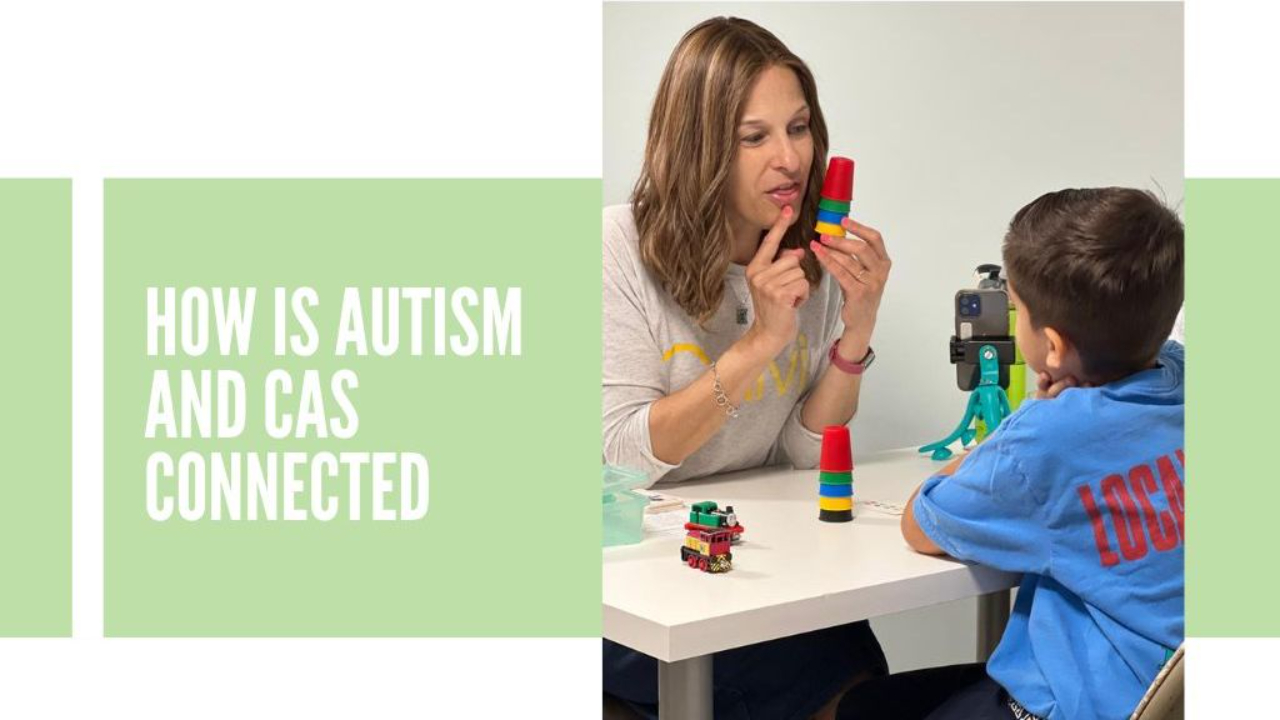
How are Autism and Apraxia connected?
Jul 02, 2026I’ve worked with autistic children for nearly 30 years. At the beginning of my career, I used traditional language therapy with autistic children, working with a team of ABA therapists and parents to develop the child’s communication skills.
We worked on communication through AAC (Augmentative and Alternative Communication) including an iPad and basic sign language. The positive thing was that these children were able to communicate in their community. But we were not always successful in developing verbal communication.
Through my motor speech training,, I realized that although we cannot make a definitive diagnosis of CAS with a non-verbal autistic child, we can effectively use a motor speech therapy approach.
And over the last 15 years, I have succeeded in using a motor speech therapy approach to develop verbal communication with many autistic children.
What SLPs need to know about the connection between autism and apraxia
It’s difficult to diagnose speech sound disorders (SSDs) for children with ASD
Molly Beiting (2022) reported that “Differential diagnosis of SSDs “Children with ASD may exhibit insufficient speech output to judge articulation, poor repetition skills, difficulty understanding task demands, poor joint attention, or decreased compliance due to interfering behaviors or poor social motivation.”
But although we may not be able to make a definitive diagnosis of CAS, clinicians “should use evidence-based assessment and treatment procedures designed for children with typical development, and adapt them as needed,” according to Beiting.
So while you may not be able to diagnose apraxia with your clients with autism, you absolutely can help them make meaningful communication progress using a motor speech therapy approach.
Are autism and apraxia the same?
Autism Spectrum Disorder (ASD) is a neurodevelopmental difference that affects areas such as communication, perception, and interpersonal relationships.
Apraxia of speech is a neurological disorder that affects the brain pathways involved in planning the sequence of movements involved in producing speech. The brain knows what it wants to say, but cannot properly plan and sequence the required speech sound movements. (National Institute of Health)
ASD and apraxia are not the same, but they often co-occur.
Many autistic children are non-verbal, which makes diagnosis a challenge. Because of the difficulty in diagnosing CAS, many clinicians only rely on traditional language based therapy techniques. The reality is that many children with ASD benefit from therapy based on the principles of motor learning.
What are the signs that CAS is co-occurring with autism?
Many autistic children are minimally verbal and may not learn to use verbal communication as their primary mode of communication.
Here is a general list of characteristics that we see in children with CAS and Autism:
- Difficulty combining sounds together
- Uses words but they mostly consist of word approximations (does not produce all the sounds in the word).
- Has difficulty imitating words especially new words
- Demonstrates groping when trying to produce sounds
One of the challenges in understanding a child's communication difficulties is figuring out exactly what is making speech hard for them.
For some children, the main challenge is planning and coordinating the movements needed for speech (Childhood Apraxia of Speech). Other children struggle more with social communication and language development.
Children with Autism Spectrum Disorder (ASD) often experience both motor speech planning difficulties and delayed language development.
What happens when a child has both autism and apraxia?
A co-occurrence of CAS and autism can be challenging for parents and clinicians alike.
Apraxia therapy requires a great deal of practice to build the child’s motor planning skills. Practice requires cooperation and attention to multisensory cues, both of which are difficult for autistic children.
Autistic children generally have sensory dysfunction, which means the SLP needs to modify the therapy techniques to account for the child’s sensory needs while still using evidence-based approaches for apraxia of speech.
How are communication challenges more complex for children with ASD?
Autistic children can have difficulty learning language and social skills. When we add motor speech challenges, learning to communicate becomes more difficult.
SLPs typically struggle with making the diagnosis of CAS with an autistic child because it’s difficult to assess autistic children. The biggest challenge for SLPs is knowing when to use a motor speech approach even when there’s no official diagnosis.
There is limited research on using principles of motor learning with autistic children, and in many clinical settings, supervisors look at research to guide treatment.
How does traditional language-based therapy fall short for communication issues that stem from apraxia and not just autism?
Language based therapy focuses on developing a child’s ability to understand and use language for communication, while motor based therapy targets accurate motor planning and sequencing of syllables and words.
Autistic children can benefit from language based therapy as well as motor speech therapy. Motor speech therapy should not necessarily replace the child’s other therapy programs.
Each child’s therapy needs and goals should be assessed on an individual basis.
What does progress look like for a child with both autism and apraxia?
Autistic children that demonstrate fair joint attention skills generally make significant progress with a motor speech approach.
Progress with autistic children, as well as children without an autism diagnosis, will vary based on a number of factors including:
- Severity of apraxia
- Severity of autism
- Frequency of therapy
- Frequency of carryover
- Early intervention
SLPs can help children stay motivated and engaged by celebrating all progress and milestones big and small.
The importance of early intervention
My clinical experience has shown that the earlier motor speech therapy begins, the more success the child will have in becoming a verbal communicator.
I am not suggesting that every autistic child who receives motor speech therapy early will be a verbal communicator. However, starting therapy early allows the child access to tools that language therapy does not provide.
Language based therapy doesn’t use the principles of motor learning.
So as soon as a child demonstrates the following precursors for apraxia therapy, motor speech therapy should be added to the child’s therapy program:
- Intent to communicate. This happens when the child shows desire to communicate with gestures or sounds
- Joint attention. This happens when a child can attend to an activity together with an adult. (Direct eye contact is not necessary.)
What are the benefits of early intervention?
When a child starts receiving motor speech therapy early, they build the skills they need to be successful with sequenced movement.
A child will often be able to produce several consonant and vowel sounds without being able to put those sounds together to produce meaningful words.
When the child first starts motor therapy at an older age they are already very frustrated by their poor verbal communication and likely have habituated incorrect motor plans. It is generally more difficult to correct a motor plan than to teach it correctly from the beginning.
After beginning apraxia therapy as early as possible, I tell parents that it feels like I “unlocked” their child’s motor speech skills. This can be a rewarding, motivating experience for children, the SLP, and parents.
Autism and apraxia together
If you’re an SLP or parent who wants to learn more about early intervention and the connection between autism and apraxia, I created a course just for you!
Autism and Apraxia Together: A Roadmap for Intervention, will help you:
- Identify and understand the co-occurrence of autism and apraxia.
You’ll learn how to differentiate between language-based intervention and motor speech intervention and why a motor-based approach is necessary for autistic children with CAS or suspected CAS. - Analyze sensory and attentional factors that influence participation in motor speech therapy and select appropriate sensory supports to optimize treatment outcomes.
- Determine when implementation of a motor speech approach is clinically indicated for autistic children who have not made progress with language-based therapy.
The course also includes multiple treatment videos and an in-depth case study discussion.
Click here to register now!
Free Target Selection Handout for CAS
Learn how to choose target words for minimally verbal children, understand
multisensory cueing, and other do's and don'ts in apraxia therapy.
