
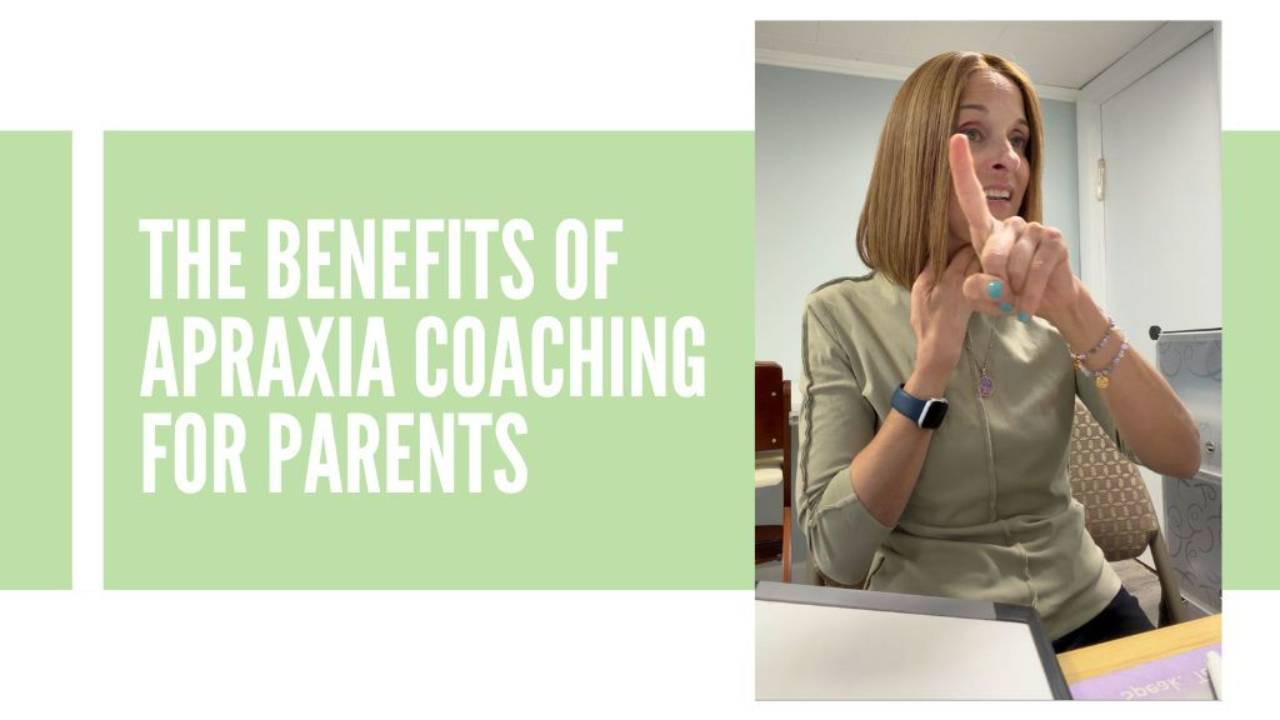
The Benefits of Apraxia Coaching for Parents
Aug 06, 2026SLPs and specialists aren’t the only ones who can help your child improve their communication.
Parents are a very powerful part of the therapy team!
With the right training and support, you can learn to engage your child in effective motor speech therapy.
It’s not your job to become a therapist. But you can learn a step-by-step process for helping your child practice at home so they can make better, more efficient progress and build their confidence even faster!
In this post, I’ll share more about what apraxia coaching is, how parents like you can help your child outside the therapy room, and how to do apraxia therapy at home.
Why do parents need apraxia coaching?
Parents are interested in apraxia coaching for a number of reasons.
Many of my clients reach out because:
- They can’t find an apraxia specialist in their area
- Their child isn’t responding well to the SLP they’re working with
- Private therapy can be expensive
- They are homeschooling their child and want to add motor speech therapy to their curriculum
- Their child works with an SLP but the parent is unable to be physically present during the session and want 1:1 guidance
Motor speech therapy is multi-layered. It’s a complex speciality that includes different therapy approaches like DTTC, PROMPT and REST, and multisensory cueing.
Motor speech therapy should always follow a specific structure known as principles of motor learning.
It’s also very challenging to motivate a young child to participate in therapy and hold their attention throughout practice.
Apraxia coaching teaches parents each of these approaches and gives you the skills, strategies, and techniques you need to effectively help your child practice at home!
Do you need apraxia coaching?
Every parent whose child receives (or needs) motor speech therapy can benefit from coaching.
You can do this, and do it well!
Taking on the responsibilities of therapy can feel daunting, especially when you do not have training in this area. But with the right coaching, parents can learn to teach their child to sequence movements into functional, meaningful words.
I’ve worked with many parents who start coaching feeling frustrated and uncertain about whether it will even be helpful, only to become more confident and capable in just a few sessions.
You may have tried to learn on your own without much success or been brushed off by a provider or professional who didn’t know how to diagnose CAS or suspected CAS.
Regardless of what you’ve been told or experienced, your instincts are almost always correct. If CAS is suspected, there’s no downside to structuring your child’s therapy using principles of motor learning, so there’s really no risk.
I’ve coached dozens of parents who can now effectively help their child start to say words or improve their intelligibility. It’s incredible to see the parent’s and the child’s confidence grow as we work together!
How does parent coaching help children with CAS?
Being an effective, trained parent who can support your child’s practice and progress at home is one of the best ways to help your child!
I work together with parents to create meaningful and functional target words to practice. Then I teach parents how to accurately practice these words with their child using multisensory cueing.
Knowing how to support your child’s apraxia therapy at home can also help negate or avoid problems that can arise when someone who isn’t apraxia trained works on speech with your child.
The most common issue I see when a professional works with a child and doesn’t follow the principles of motor learning is negative practice. This means the child is practicing the word with the wrong movement pattern and building an incorrect motor plan.
Inaccurate practice can make it harder for your child to make progress.
It’s very important that each trial is practiced with accurate movement patterns. This is what dynamic therapy (like motor speech therapy) is all about.
A parent who has gone through proper apraxia coaching and training can avoid negative learning by:
- Providing cueing
- Listening to and observing the child while they speak and making changes in real time
- Adjusting cueing to elicit accurate productions of the target word
Most parents are eager to help their children with their speech and communication.
But before you dive in and start trying to practice at home, you need to have the right techniques and tools.
How does apraxia coaching help?
Apraxia coaching is helpful because you have a specialist training you on what to do and checking in on a regular basis to review your child’s program and tweak your techniques as you progress.
Here are things that help home practice be effective
- Daily practice sessions
- Use of open-ended toys
- Follow the principles of motor learning
- Be engaging, with ongoing cooperation from your child
Want to learn how to support your child with CAS?
The cadence and frequency of apraxia coaching looks different for every parent. We will work together to create a schedule that works for you!
Coaching sessions are structured depending on how much training and support parents and families need. Some of my clients meet with me once a week, while others meet once a month.
I also offer apraxia coaching for your child’s SLP to help them choose effective target words, use specific cueing techniques, and improve cooperation during their sessions.
If it’s helpful, I also can meet with parents and the SLP together.
I’m currently coaching a parent of a 3-year-old autistic child and has suspected CAS. He’s been trying to produce words, but is having difficulty sequencing the sounds and his words are often unintelligible.
His mom follows me on social media and reached out to start coaching sessions. The progress has been incredible!
She works outside the home, has three small children, and is quite busy, so we began by working together on Zoom once a week and have now shifted to once every other week.
Since shifting to a motor speech approach and learning how to support his motor speech therapy practice, the child is spontaneously using words to communicate his needs!
With the tools and techniques I’ve taught her, his mom is confident in helping him improve his speech clarity.
Many parents feel lost and overwhelmed by the time their child is diagnosed with CAS or suspected CAS.
Apraxia coaching is one of the best ways to understand what your child needs and support them as they improve their speech and communication.
Here’s what a couple of my clients had to share about the experience of apraxia coaching with me:
“Being a fellow SLP and a parent of a child with Apraxia, I was lost. Speaking to Alonna gave me the confidence and tools I needed (one at a time) to make progress with my son's speech. Being continents away and a different time zone was no barrier for Alonna. After our first meeting and choosing some targets, my son who always left out the final consonant started saying his favorite word completely for the first time. From “boo” to “book,” he is constantly behind me to read a book. So many more words , so many more tips and instilling a focus and "don't panic" assurance is what I needed. Thank you Alonna!”
“We have worked with several in-person speech therapists in the past. Working with Alonna Bondar over Zoom has been by far the most successful! She is incredibly smart, supportive and insightful- always coming up with impactful suggestions that make a true difference. The flexibility of meeting over zoom has made it so much easier to stay consistent! It allows full parents involvement which I personally think is needed for success. I am so grateful we found Alonna.”
Want to book your first apraxia coaching session? Click here to get more details and let me know you’re interested!
I work with parents over Zoom and can accommodate most time zones and locations!
If you’re interested in learning more about how to support your child with CAS, click here to check out my CAS Roadmap for Parents course.
You don’t need to be an SLP or apraxia specialist to effectively support your child’s motor speech practice and progress! You just need the right coaching, training, and support.
Free Target Selection Handout for CAS
Learn how to choose target words for minimally verbal children, understand
multisensory cueing, and other do's and don'ts in apraxia therapy.
